I can’t decide whether I like LSB 445 or not, “When You Woke that Thursday Morning”, but I’ve always been mesmerized by the fact that death comes suddenly without forewarning, and maybe even foreboding, but not without foreknowledge. We all know death is not an if but a when. We use the fact that infants die to prove the doctrine of Original Sin. But what were Kennedy’s thoughts that Friday morning when he woke in his Dallas hotel?
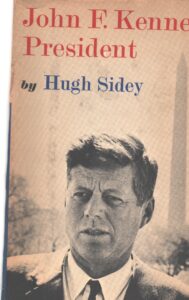
That’s where the above book comes in. It had been on my parent’s shelf since 1964 the first time I saw this book I said to myself, “One day I will read that.” It took me 60 years to do so, but I have, and I’m glad but haunted.
First, some background. As any parishioners of mine could know and might remember, November 22, 1963 I was sitting on my first grade teacher’s lap in the Lutheran School I attended in Saginaw, Michigan. I was there because that was the only means anyone could think of keeping me at school. I kept walking home whenever I felt like it. We had recently relocated from California back to my parents’ home state.
I kept leaving school and walking home. The issue for my poor mother was the railroad tracks. She didn’t think I had sense to stay out of the train you might paraphrase. So, there I was on Mrs. Sengle’s lap. She was reading to the class. I was looking over her shoulder at a colored picture of a Boeing 707. The principle broke into class over the intercom. I knew it was serious. I knew it was about “The President”, but I didn’t know it was a tragedy till I felt my teacher’s whole body tense up, and looked up to see a single tear making its way down her cheek.
My folks were not Kennedyphiles. My mom gave birth to my last sister on November 5, 1960 and begged the doctor to let her go early, November 8 (5-day-stays postpartum was the norm.) to vote for Nixon. This is somewhat strange since my mom’s people were union men. My grandfather was a union rep for the railroad and an uncle was for the UAW. My father’s people were decidedly nonunion his father, my grandfather, having been blackballed for refusing to join a union at his tool and dye plant right before the Depression and so was out of work for all of it.
This is way too much background. The book haunted me because that day did…in a sense. I peed the bed that night for the last time after a long time of not, but strangely my mom was not upset. She seemed apologetic. I didn’t know why she was or why I had done it at all. I do now.
So I read the book. The first 27 chapters were written before the President was killed. The last chapter is the only one postmortem. The author says he changed not a word of the those first 27 chapters and Kennedy read them, approved them, with one small change. That’s a cliffhanger you’ll have to solve by reading it.
Kennedy only won by 2/10th of a percent says this book John F. Kennedy, President. Other sources says l/10th. In any event, he wasn’t all that popular. But this author loved him. It reads more like a tribute than a biography, but remember neither author nor subject know the subject will be dead before the year it was first published would end.
But you do. Every word of praise and criticism by the press, by politicians, world leaders, is surrounded by a dirgeful tune playing in the background of my head. The “gaganess” of the world about Jackie is haunted by an elegiac cadence. I hear the drumbeat of Death drawing ever closer. I know exactly how much longer he has in office. The futility of planning for a second term. He doesn’t. His wife doesn’t. The nation doesn’t. God only knows, but He didn’t tell then (or now by the way). In Dallas, Kennedy did remark that a he could be killed from a bullet fired from one of these skyscrapers. Was that a warning? Incidentally, the bubble top that the limousine could be equipped with was not meant to, and could not in fact, stop a high powered rifle shot. It was for weather and to keep people away.
Short stories, books, I even think a Star Trek episode have been about what if Kennedy hadn’t died? I mean: Douglas MacArthur tells Kennedy in a private meeting, according to Kennedy himself, “He said that we shouldn’t put one American soldier on the continent of Asia – we couldn’t win a fight in Asia” (188). All indications are that Kennedy was pulling back from Vietnam. Johnson, not wishing to appear soft on Communism, double-downed, and put over 500,000 American’s in Asia, and we have a wall of over 50,000 them who certainly would have wished that Kennedy hadn’t died.
You know in point of fact the only person it matters whether or not he died, the only one the what-if scenario of not dying is not heartening but scary, is Jesus. If He doesn’t die and not just die but be damned, you and I and everyone else do both. And because He didn’t live, because He wasn’t spared, we and all our loved one’s in Christ dead or alive, do live and will thrive.
The last paragraph of the book, written after the horrible day in Dallas, is moving. “John Kennedy’s eyes were often drawn toward the horizon. …He would wander down a Cape Cod beach to feel the wind and look, think, beyond the moment. He used to gaze beyond the waves from his boat, and would stare from a plane window toward infinity. Now he was there” (355).
The difference between Zwingli and Luther is that Zwingli believed certain pagan philosophers were in heaven. Luther wished they could be. Cue the hymn: “Abraham Martin and John”.
