
I made the mistake of titling a blog “The Most Controversial Ever” because I couldn’t think of a title before, during, or after writing. One of my sons saw it and wrote, “Which of your posts aren’t controversial?” Well, I think this one will certainly be.
Let’s start here with the Texas Empowerment Academy Kindergarten Promotion Ceremony May 27, 2025. I literally found this blowing in the wind as in the eponymous song. And I don’t have an answer, apart from Law and Gospel and Christ crucified, to genuine racism. But I think so-called systemic racism has become the second-hand smoke which explains why non-smokers die of lung cancer. Systemic racism explains why all persons of non-color can’t but be racists.
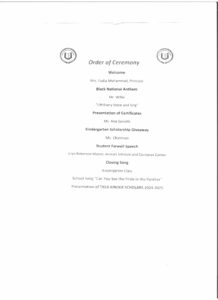
The Texas Empowerment Academy is a K-12 charter school funded primarily by taxpayers to the tune of 11,456 per student annually. US News and World Report says: “Texas Empowerment Academy contains 2 schools and 399 students. The district’s minority enrollment is 100%. Also, 54.6% of students are economically disadvantaged.” It also reports that 89.4% of its funding is from State and Federal government with 10.6% coming from local donors for a total of 5,625,000 (https://www.usnews.com/education/k12/texas/districts/texas-empowerment-academy-113001). Am I wrong or is this the equivalent of the much demonstrated and legislated against “separate but equal” which is considered Jim Crow doctrine?
Did you see that the Ceremony opened with “Black National Anthem”? Here’s what the NAACP says about the song: “Often referred to as “The Black National Anthem,” “Lift Every Voice and Sing” was a hymn written as a poem by NAACP leader James Weldon Johnson in 1900. His brother, John Rosamond Johnson (1873-1954), composed the music for the lyrics. A choir of 500 schoolchildren at the segregated Stanton School, where James Weldon Johnson was principal, first performed the song in public in Jacksonville, Florida to celebrate President Abraham Lincoln’s birthday. At the turn of the 20th century, Johnson’s lyrics eloquently captured the solemn yet hopeful appeal for the liberty of Black Americans. Set against the religious invocation of God and the promise of freedom, the song was later adopted by NAACP and prominently used as a rallying cry during the Civil Rights Movement of the 1950s and 1960s.”
Are you familiar with the argument that by our intervening in the Middle East we are just insuring the next generation of Anti-American Jihadists? Is that argument to me made here?[i] I could see having the so-called “Black National Anthem” opening or closing more so if they had the National Anthem in the ceremony at all.
As an Army Reserve Chaplain in the 90s in the New Orleans area 4 out of my 5 units were majority African-American. Since I was the chaplain I was in charge of almost every celebration, so Black History Month fell to me. I did learn a lot. I did feel weird, not from fellow soldiers but by the situation, when we sang “We Shall Overcome.” It is definitely a hymn not a song in the Black community.
But to have a Black National Anthem seems to imply the other is for whites only. Should it? In Detroit a neighboring pastor used non-denominational Sunday School materials – that was in the 80s and I can’t remember what they were – I pointed how out how Reformed, Evangelical, non0denominational, and just plain wrong they were. He said, “I know, but they are the only materials that show people who look like our people.” He was white but at an all-black congregation. Was this wise or just a difference in degree but not kind from “Christa” the 1975 female depicted crucified Christ? It was big news when it went on display in St. John the Divine in New York in 1984. You see, defenders said, this crucifix for once looked like the other half of the population.
Back to my collogue in Detroit. As my first Call was to North Zulch, Texas which “wanted a candidate from a rural background” (Swing and a miss there), he was Called out of seminary to a church who “wanted an African-American”. Neither he nor his Mrs. were. He was a gifted preacher who used popular slang. In the throes of preaching, he used an expression popular to those of us growing up in the 70s, “I was free, white, and 21”. He was horrified and immediately apologized. It was “no thing” to his congregants. Amazing.
His congregation was special. As an Army Reserve chaplain, I would represent my commander at funerals. I went to the funeral of one of our soldiers who had died suddenly. I had never been to a Black church before. The emotion was palpable and freely expressed by words, tears, and in song, rhythmic movement, and clapping.
I mentioned this to my collogue of the ethnically correct but theologically wrong Sunday School Material. He said, “When I first got here, right away I attended the funeral of someone related to my member. It too was Motown and Blues, shaking and dancing, and lots of clapping and cheering.” He went on to say, “My member leaned over to me and said, ‘We don’t do this sort of thing at our church.”
Now I pivot, to your surprise and perhaps awe, to Texas Highways’ December 2024 issue and the article “Preserving Traditional Black Gospel Music”, by Cynthia J. Drake. It opens, “Michael Robertson grew up singing church songs out of hymn books—classics like ‘Pass Me Not, O Gentle Savior’ and ‘Lord, I Want to Be a Christian.’ He attended Methodist and Baptist churches where music wasn’t known for extravagance, and choirs weren’t allowed to move, clap, or jump. But in 1965, he experienced something transformative” (32).
It seems to me – and here we get controversial – the swaying, clapping, and dancing evidenced in the hit 90s movies “Sister Act” is not characteristic of how historically African-Americans worshipped till it became permissible, acceptable, and even expected in the “beloved” 60s. It is akin to what I’ve heard happens in parts of Mexico that instead of the usual words that accompany signing yourself with the cross they say, “In the name of the Father, and of the Son, and of the Virgin Mary.” (This may be a category error on my part. Including the Virgin Mary in the invocation is heresy, but is acting out, or up, failing to do Divine Service orderly according to our ways of worship heretical or unwise? Is it incorporating unchristian ways of worship or just different ways?)
What are we to make of these things? All of this attention on ethnicity, multiculturalism, universality seems counterproductive. Over fifty years ago a black drill sergeant stood in front of my Basic Training Company made of 1/3 blacks, 1/3 whites, and 1/3 Hispanic and bellowed, “There is only one color in this man’s Army and that is OD [olive drab] green.” I was afraid of him then and afraid now that we have gone so far away from his simple wisdom there is no way back.
[i] Daniel Patrick Moynihan in 1965 produced the study “The Negro Family: The Case for National Action.” This was partially behind President Johnson’s THE GREAT SOCIETY legislation passed at the time. If I hadn’t foreworn using AI I would ask it – though I really don’t know how much it can/should be trusted – to compare the statistics he amassed with those from 2025. My hypothesis is that the Black community is worse off now than it was then. Not because of systemic racism but because money, particularly government money, can’t buy real change in society in general and the Black community in particular.
