
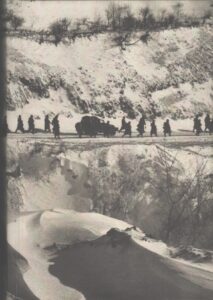
You’ve heard the saying that revenge is a dish best served cold. There are some things only served cold, too cold to bear.
The Coldest Winter is the title of a 2007 book about the Korean War by David Halberstam. I read it 10 years ago and am still haunted by one anecdote in it.
Lt. Col. Edgar Treacy was a battalion commander in Korea. He went forward repeatedly with his troops to take Hill 174. They went from 900 to 292 men. He refused the order to try again and was called ‘yellow’ in front of other battalion commanders. “’At night, some of the other officers had noticed that he seemed to be mumbling to himself just before he went to sleep. At first they thought he was saying his prayers. One officer asked if Treacy were reciting Hail Marys. No, the answer came back, he was reciting the name of each man in his battalion who had died and asking God’s forgiveness for his own responsibility in his death’” (Coldest Winter, 573).
That’s what I’ve noticed in retirement. I am haunted, sometimes in my dreams, often in my thoughts by numberless, often nameless, sometimes faceless but no the less real people I’ve “lost”. I remember times where I should’ve used Gospel and used Law instead. I remember people who were so promising who just stopped coming and faded away as if they were never there. I remember some I didn’t do enough to reach and some I did too much. I remember, regret, and die a little more each time I do.
As any Confessional Lutheran knows the idea is to die in your Baptism to the bad, the ugly, and even what the flesh might consider good. But like the Chinese water torture, which is a real thing, the drip by drip of memory starts and bores into my limestone soul.
I don’t know if it’s a fact, or 1950’s Western’s lore, that gunfighters notched their gun for each kill in a dual, but I do know when I asked a Coast Guard Rescue Swimmer how many people he had saved, he replied almost proforma, “Oh you never remember the ones you save, only the ones you didn’t.”
There’s the rub. It’s the endings that count. I once taught a woman who wrote down every single thing I said in Adult Class. She was an engineer, very intelligent, and seemed to understand and was converted from Evangelical shallowness to Confessional Lutheranism. But she almost never came to church. When I asked her about it, she was upfront about only joining because she could see how committed I was and felt sorry for me.
St. Sullivan saved me from that crash and burn. He said, “Paul, you don’t know that when that women is in her 40’s and is diagnosed with Stage 4 breast cancer she won’t remember God’s Words through you and so be saved in the end.”
One of my dad’s favorite poems was along this theme: “If you go to heaven, You will likely view/ Many folks whose presence there, Will be a shock to you./ But just keep very quiet; Don’t even stare./ Doubtless there’ll be many folks, Surprised to see you there.”
This poem is attributed to Edgar Bernhard with no date. You will find lots and lots of like poems all over social media most being used to justify “no judging”, “all dogs go to heaven”, or “sleep, sleep my beauties no need to worry about the afterlife.” None of these are my point. My point is that to have regrets about what you cannot know, how something ends, is to play God and is more bitter than death.
This last line comes from Ecclesiastes 7:26, “And I discovered more bitter than death the woman whose heart is snares and nets, whose hands are chains.” This is the adulterous woman of Proverbs 5. It’s better translated “strange” woman. She is the opposite of divine Wisdom. This is bad theology versus good, really satanic versus divine. This is the two kinds of wisdom spoken of in James 3.
So to continually return to the ones you lost as the tongue searches for the empty socket where your tooth use to be is earthly wisdom which James describes as “unspiritual, demonic”. He goes on to says in 3:17, “But the wisdom from above is first pure, then peaceable, gentle, reasonable, full of mercy and good fruits, unwavering, without hypocrisy.” And then for the pièce de résistance we have verse 18: “And the seed whose fruit is righteousness is sown in peace by those who make peace.”
Until one in Christ through Him alone makes peace with their past they are left out in the cold, the cold of regrets unlimited, and that might be properly described as “cold as hell”.
