
Here’s a title to rival Lutheran sermon titles from the 17th and 18th centuries. Let’s see if I can make it make sense.
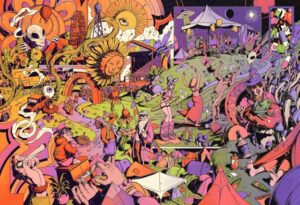
“Sobriety and Ecstasy” was the title of the February 2025 Harper’s. It’s corresponding feature story was entitled “High and Dry – Sobriety and transcendence at Bonnaroo”. This picture was the cover art. I think Barrett Swanson is either a vocabulary savant or an idiot who used Google to look up 5-dollar synonyms for 50-cent words. How many of the following words do you know? Some I did not know at all; some I had a vague recognition of, but I was helped by context.
Lotus-eater, throuple, sartorial, troika, being my Virgil, senescence, sozzled, sumptuary, NoFapper, sedulous, prelapsarian, apothegm, appurtenance, patchouli-scented, exigently, convolved, sororal, arpeggios. What’s more these 5-dollar words were frontloaded in the first half of this approximately 5,000 word article.
Wikipedia tells you, “Bonnaroo is an American annual four-day music festival developed and founded by Superfly Presents and AC Entertainment. Since its first year in 2002, it has been held at what is now Great Stage Park on a 700-acre farm in Manchester, Tennessee.” The author is living a sober-life and he is writing about being in a group of like-minded men and women at this booze and drug soaked Bacchanal. Apparently every one of these sorts of festivals have sober camps. And, contrary to what I thought, these Burning Man-esque festivals are all over the country not just in the Nevada desert.
In the 1980s I observed to my wife that weekend festivals were replacing church. There was one every weekend within driving distance when we were in Texas and Michigan. Barrett Swanson, of big vocab fame, observes: “Overnight camps like Bonnaroo—and with it, places like Coachella, Burning Man, Electric Forest, etc.—turn out to promise more than just a safe, welcoming sanctuary for unbridled libertine carousing. Instead, what they offer is much more fundamental, a cleansing of perception, a wholesale spiritual rejuvenation. The obvious precursors here are the tent-meeting revivals of the Second Great Awakening, where scores of flagging believers tramped to God-haunted countrysides to take part in massive outdoor spectacles, ones meant not only to enlist newly ensorcelled congregants but also to perform CPR upon those scores of toilworn Christians who’d grown disenchanted after the Enlightenment” (26).
Here’s the leap to Church Grow, aka contemporary worship, bleeding-edge Christianity, back in 1982 a new pastor came to my parent’s Lutheran Church Missouri Synod congregation. Immediately he started the “Boar’s Head Festival”. It was popular. It got loads of people involved. It was something to invite your friends to. It was year-round planning and preparation – a reason to be involved with church. Good Shepherd, Cedar Park, Texas, led now my a non-Master of Divinity educated pastor, started under their last pastor “Follow The Star” at least 16 years ago.
What I said about the “Boar’s Head Festival” applies to “Follow the Star” and is using the principle espoused at every single nominating committee meeting I attended over 40 years. “Let’s nominate him; that will get him involved.” He may not come to church but Christmas and Easter or even less, but you get him involved and he will be here.
Do you get it? These yearlong church-sponsored special events attract the festival addicted Americans which in turn are mimicking American revivalism. If you want to hear someone go off, if you want to read a 19th century rant, read some of the first president of the LCMS, C.F.W. Walther’s, comments on revivalism.
These perpetual year-long projects are popular ways to call and gather 21st century people, but they enlighten with another spirit’s gifts (even if you are sober), and do not sanctify or keep people in the true faith. Rev. Robert Hill, surely sainted by now, one of the best of the WW II generation pastors thought I was a “loose cannon”. Actually, he didn’t say that, he said that others had said that to him. In any event, he did say to me in that conversation that I was right when I likened the LCMS bureaucracy to the first televisions with tubes. If the set was bad, it blew the new tube as soon as you replaced the old one. Rev. Hill now agreed with me: “We do elect good men to office in the district and synod and they go bad fast.”
These new mimics of today’s festivals and yesterday’s revivals are blowing much good theology and maybe even a few good men.
Finally, a lay member of my congregation in Louisiana stopped by to see me in Austin years after I had left that parish. He was a very successful businessman who attended Divine Service faithfully but very rarely said anything. He stopped by to tell me that I was right when he had heard me say years before but hadn’t believed me at the time: “What you win people with that’s what you win them to.” Now ain’t’ that a sobering thought for all those “churches” being founded on festival-like productions?
